
Quick Takeaways: Red Light Therapy for Body
Using a panel at home? Position yourself 6 to 12 inches away on bare skin and treat each area for 10 to 15 minutes.
Are you a clinic or gym owner looking to standardize this as a professional service? Simply placing a light in a room is not a scalable protocol. Read our deep dive below into commercial “body choreography” to maximize throughput, sanitation, and client safety.
In the commercial wellness sector, purchasing equipment is often the easy part. However, the real challenge—and where many businesses struggle—is operationalizing that equipment into a safe, repeatable service. For instance, for facility owners reading our red light therapy business articles, the most common question isn’t usually about nanometers; rather, it is about workflow. How do you turn a 15-minute session into a consistent “full-body” experience that clients value?
Consequently, this guide moves beyond generic advice. We will treat “red light therapy for body” not just as a technology, but as a “coverage choreography” problem. Below, we provide the frameworks, decision matrices, and program card templates necessary to run a professional body-focused service without overpromising or risking compliance. Teams building weight-management or metabolic-wellness program cards can also use our red light keto fasting guide to align session choreography with cautious nutrition-related messaging.
What “Red Light Therapy for Body” Really Means in a Professional Setting
Why full-body is a consistency problem, not a “stronger light” problem
Most B2B buyers obsess over device power, assuming a stronger light yields better results. In reality, from an operational standpoint, the success of a session depends on consistency. For example, a client standing 6 inches away receives a vastly different experience than one standing 18 inches away. Therefore, if one staff member instructs a client to “stand close” and another says “stand back,” your service quality fluctuates wildly.
How to describe benefits without medical overclaims (safe language examples)
To ensure longevity, regulatory compliance is critical. Unfortunately, many studios invite risk by using medical language like “treating back pain” or “curing inflammation.” Instead, successful studios frame benefits around “support” and “environment.”
- Unsafe: “This device treats chronic arthritis and reduces inflammation.”
- Safe/Compliant: “Red light therapy supports joint comfort and may help manage the minor aches associated with daily activity.”
- Unsafe: “Clinically proven to heal muscle tears.”
- Safe/Compliant: “Designed to support the body’s natural recovery process after intense training.”
The Core Skill: Full-Body Coverage Choreography (3 Patterns)
Front–Back rotation: when it’s the simplest starting point
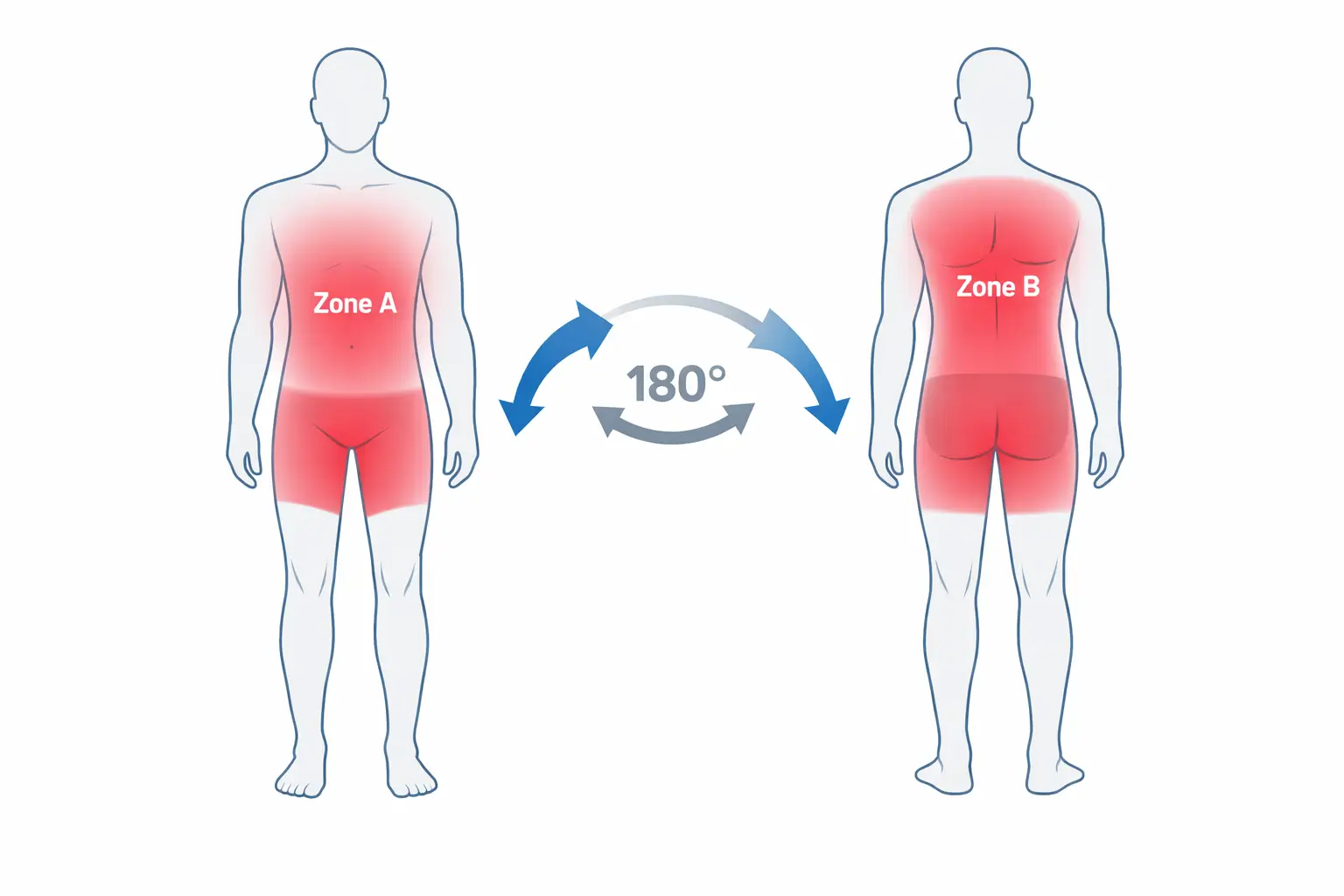
For studios using vertical wall-mounted panels, the Front-Back rotation is the industry standard. This setup is intuitive: the client stands or sits facing the light for 50% of the session, then turns 180 degrees for the remaining 50%. Although it offers high throughput, it may miss the sides (flanks) without extra turns.
Flip protocol: how mats change choreography
However, if you utilize horizontal devices (beds or mats), the choreography shifts to “The Flip.” Gravity becomes a factor here. While lying down is more relaxing, asking a client to physically flip over halfway through a relaxing session can break the “spa state” or “parasympathetic downshift.”
Split-zone rotation: how studios keep throughput without rushing
Many gyms find that 20 minutes (10 front/10 back) is too long for busy members. As a result, the Split-Zone rotation solves this by focusing on one quadrant per session:
- Day A: Anterior Chain (Front torso/quads) – 10 mins.
- Day B: Posterior Chain (Back/hamstrings) – 10 mins.
Panel vs Mat vs Sleep Bag: Match the Format to Safer Choreography
What changes for comfort, heat tolerance, and cleaning workflow?
Operationally, cleaning is the hidden bottleneck. On one hand, panels have zero skin contact (1-minute turnover). On the other hand, mats require medical-grade wipe-down between every client (5–10 minute turnover).
| Feature | Large Panels (Wall/Stand) | Flexible Mats (Lie-down) | Sleep/Wellness Bags |
|---|---|---|---|
| Choreography Fit | Front-Back / Split-Zone | The Flip (Manual turn) | Full Enclosure (No move) |
| Throughput Speed | High (Self-service) | Medium (Sanitization time) | Low (Setup + Sanitization) |
| Comfort/Heat | Airflow is high (cooler) | Warm (conductive heat) | High heat (sweat risk) |
| Staff Training | Simple (Stand at line) | Moderate (Positioning) | Complex (Fitting/Zipping) |

Dose, Distance, and Frequency: How Studios Make Results More Consistent
Why “more is not always better” (use Huang et al., 2011)
Commonly, a mistake in B2B operations is allowing clients to “double up” sessions. However, research such as the review by Huang et al. (2011) highlights a “biphasic dose response.” This finding implies a “sweet spot” for biological response; excessive energy can negate benefits. Consequently, your studio protocols must enforce maximum session times.
Typical distance/time/frequency ranges used in practice
- Distance: 6 to 12 inches (Standard for panels). Closer than 6″ is often too hot; meanwhile, further than 18″ is inefficient.
- Time: 10 to 20 minutes total.
- Frequency: 3–5 days a week allows for necessary rest periods.

Program Library: 3 Full-Body Program Cards
Copy these templates to print and post near your devices.
Program Card A — Recovery Support (Athletes)
- Goal: Support muscle recovery after intensive exercise.
- Target Zones: Large muscle groups (Quads, Hamstrings, Back).
- Distance: 6–10 inches (closer for deeper support).
- Time: 10–15 minutes total.
- Frequency: 3–4x per week, ideally post-workout.
- Stop Rule: If skin feels uncomfortably hot or sweating is excessive, stop.
Program Card B — Comfort & Mobility Support
- Goal: Promote general joint comfort and mobility (non-medical).
- Target Zones: Full body or specific joints.
- Distance: 12–18 inches (gentler, wider coverage).
- Time: 15–20 minutes total.
- Stop Rule: Stop immediately if stiffness increases.
Program Card C — Downshift & Relaxation
- Goal: Support relaxation and preparation for sleep (Evening).
- Distance: 18+ inches (Lower irradiance, ambient feeling).
- Time: 20 minutes.
- Stop Rule: If user feels “wired” or overly alert, switch to NIR-only or discontinue evening use.
Buying Checklist for Business Owners (Beyond Wavelength)
Many manufacturers list irradiance at 0 inches, which is irrelevant for panels. Therefore, you need a device that maintains therapeutic power at the distance your choreography requires. Refer to our professional studio panels for examples of consistent field engineering.
- Disclaimer Visible: Is the “Not Medical Advice” sign posted?
- Language Check: Removed “cure,” “heal,” and “treat” from scripts?
- Photosensitivity Screen: Intake forms ask about medications (e.g., Isotretinoin)?
- Stop Rules: Does the client know they can stop at any time?
- Placing panels too high or low (missing head or calves).
- Not cleaning protective eyewear between users.
- Allowing clients to stare directly at LEDs without protection.
- Selling “detox” claims (high regulatory risk).
- Ignoring heat buildup in small, unventilated rooms.
Example Playbooks: 3 Common B2B Setups
Gym recovery corner (Throughput-led)
Layout: Semi-private dividers. Device: Large vertical panels. Key: Speed. Users keep thin gym clothes on or expose target areas quickly for a 10-minute session.
Wellness studio room (Comfort-led)
Layout: Private room, sound machine. Device: High-end panels or bed. Key: Experience. The red light is part of a 20-minute relaxation ritual.
Need a Tailored Choreography Plan?
Don’t guess on your room layout. Tell us your dimensions and expected traffic.
Contact Youlumi ConsultantsFAQ – Red Light Therapy for Body
A: Most commercial protocols suggest 3 to 5 times per week. Although daily use is possible, rest days allow the body to process the biological response.
A: Panels are superior for sanitation and throughput (no contact). Conversely, mats are superior for relaxation but require rigorous cleaning.
A: For high-power professional panels, 6 to 12 inches is the typical therapeutic window. Closer is too hot; meanwhile, further is inefficient.
Conclusion: A Framework You Can Actually Run
Success in offering “red light therapy for body” doesn’t come from making the boldest medical claims; rather, it comes from running the smoothest operations. Whether you choose standing panels or relaxing mats, remember the core variables: Distance, Time, and Frequency. Control these, and you control the quality of the result.
Planning a Facility Upgrade?
We help clinics and gyms design scalable red light setups. Send us your floor plan and service goals.
Request a Professional Layout ProposalWe provide panel counts, zoning controls, and staff training plans.


