
Introduction: Beyond Intensity, How Light Frequency Is Redefining Sleep Protocols
For practices at the forefront of wellness, the conversation around red light therapy for sleep is evolving. While wavelength and intensity are key, a new parameter is now emerging: frequency. This guide explores how specific pulse frequencies, particularly 0.5–1 Hz, could redefine your approach. Ultimately, this may help you offer clients superior results in non-invasive sleep enhancement.
The Foundation of Rejuvenation: Why We Must Focus on Slow-Wave Sleep (SWS)
Before exploring light frequencies, it’s crucial to understand our primary goal. This is where slow-wave sleep (SWS), or deep sleep, takes center stage.
Slow-Wave Sleep: The Brain’s “Clean-Up” and “Repair” Crew
Slow-wave sleep is the deepest phase of our sleep cycle. During this stage, the brain produces high-amplitude, low-frequency brainwaves known as delta waves (typically 0.5–4 Hz). Your brain isn’t just resting; instead, it’s actively performing critical maintenance. Think of it as a highly efficient overnight team that cleans and repairs. This is when the brain’s unique waste-clearance pathway, the glymphatic system, is most active. As a result, it flushes out metabolic byproducts that accumulate during our waking hours.
From Memory to Hormones: The Core Functions of SWS
The importance of SWS extends far beyond simple rest. In fact, it fundamentally links to several key functions:
- Memory Consolidation: SWS plays a vital role in transferring new memories from short-term to long-term storage.
- Hormonal Regulation: This phase is critical for releasing growth hormone. This hormone is essential for cellular repair, muscle growth, and overall physical restoration.
- Immune Function: Adequate SWS is also necessary for a robust immune response.
Without sufficient SWS, we not only feel groggy. We also compromise our cognitive function, physical recovery, and long-term brain health.
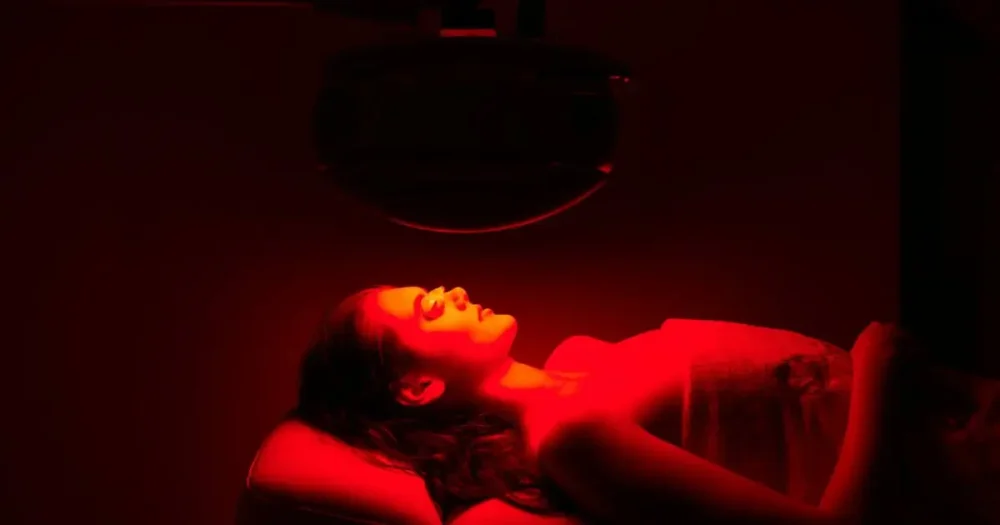
Red Light Therapy and Sleep: From Continuous Light to Precise Frequency
Initially, the application of red light therapy for sleep was straightforward. It mainly focused on its ability to act as a safe, non-disruptive light source in the evening.
Traditional Use: How Continuous Red Light Helps Regulate Circadian Rhythms
Most conventional red light therapy devices use continuous light. This approach’s effectiveness primarily links to melatonin production. Unlike blue light from screens which suppresses melatonin, red light does not interfere with this crucial sleep hormone. For example, a 2012 study on elite female basketball players found that 30 minutes of red light therapy each night improved sleep quality and serum melatonin levels. The benefit, therefore, might be twofold. It actively promotes relaxation while passively avoiding the sleep-disrupting effects of blue light.
The Advent of Pulsed Light: Moving Beyond “Illumination” to “Information”
Pulsing delivers light in rapid on-off cycles. This process introduces a new variable: frequency, measured in Hertz (Hz). This transforms light from a mere metabolic stimulant into a carrier of rhythmic information. Consequently, pulsed light therapy (PLT) attempts to communicate with the brain in its own language—the language of brainwaves.
The Core Hypothesis: Can Frequencies Enhance Deep Sleep?
This is where the research frontier truly lies. The excitement around the 0.5–1 Hz frequency isn’t arbitrary. Instead, it rests on a compelling theory of brainwave synchronization.
The Brain’s Rhythm: The Link Between Slow-Wave Sleep and 0.5–4 Hz Delta Waves
As mentioned, the dominance of slow, powerful delta waves defines SWS. These waves oscillate between 0.5 and 4 Hz. The central hypothesis suggests that we might encourage and amplify these natural brainwaves by delivering a sensory stimulus, like light, at a matching frequency.
Indirect Evidence from Other Modalities: Lessons from Sound and Electrical Stimulation
While direct evidence for 0.5-1 Hz pulsed red light in humans is scarce, we can find compelling clues in other fields. For example, studies using auditory stimulation have successfully enhanced slow-wave activity by playing soft clicks in sync with a person’s brainwaves.
Research on transcranial electrical stimulation is even more persuasive. A landmark 2006 study in Nature by Marshall et al. offers a powerful example. In this research, scientists applied electrical stimulation (tDCS) to the brain during sleep. The results showed a significant boost in memory task performance the next day, which supports the principle that external stimulation can influence deep sleep.
Neural Entrainment: How Light Pulses Could “Talk” to Brain Waves
The underlying mechanism for this is called neural entrainment. This term refers to the brain’s tendency to synchronize its own electrical activity with an external rhythm. The idea is that when we deliver 0.5–1 Hz pulses of light transcranially, they could nudge neuronal populations to fire in greater synchrony. This, in turn, could strengthen the slow oscillations that characterize deep sleep.

Evidence for Red Light Therapy Sleep Protocols: What We Really Know
- Direct Evidence: Currently, research directly testing 0.5–1 Hz pulsed red light on human SWS is very limited. In fact, it remains largely in the exploratory phase, and we lack large-scale trials.
- Indirect Evidence: The hypothesis builds upon the success of other modalities, like tDCS and auditory stimulation. It also draws from animal studies exploring photobiomodulation.
- Boundary of Evidence: The current understanding is a theoretical leap. While the principle of neural entrainment is well-established, an open question remains. Is red light an effective medium to achieve SWS entrainment in humans?
Ready to Explore Advanced Red Light Therapy Solutions?
Contact Our Experts for a professional consultation, or learn about our OEM/ODM Solutions for your practice.
Low-Frequency vs. Continuous Light for Sleep: The Potential Difference
- Continuous Light: Scientists primarily consider its effects biochemical and metabolic. It works by stimulating cytochrome c oxidase in mitochondria. This, in turn, boosts cellular energy and reduces inflammation, which can indirectly support better sleep. You can learn more about the general red light therapy benefits here.
- 10 Hz / 40 Hz Pulsed Light: Researchers often use these higher frequencies to target other brainwave states. For instance, 10 Hz aligns with alpha waves for relaxed wakefulness. 40 Hz, on the other hand, aligns with gamma waves for cognitive processing. Therefore, their application gears more towards cognitive enhancement than deep sleep.
- 0.5–1 Hz Pulsed Light: In theory, this low frequency works as a neuro-modulatory tool. Its primary goal is not just to energize cells. It also aims to provide a rhythmic signal that directly influences the brain’s electrophysiological behavior.
Clinical Applications & Research of Red Light Therapy for Sleep
- Potential Application: For example, clinics could explore 0.5-1 Hz pulsed red light as a non-pharmacological adjunct therapy for individuals with disrupted SWS.
- Device Considerations: Professional-grade equipment with precise frequency controls is essential for any clinical application. For instance, high-power units like the 1700W panel or versatile options such as the 600W panel offer this required precision.
- Compliance and Ethics: When discussing this with clients, it is paramount to frame it as exploratory research. Always avoid making unproven medical claims and clearly communicate the evidence’s current limitations.

Safety and Guidelines for Red Light Therapy Sleep Protocols
- Known Safety Parameters: Always adhere to established guidelines for dosage, including irradiance and time. This ensures energy levels remain within safe, non-thermal limits. Furthermore, understanding the contraindications for red light therapy is a crucial part of safe application.
- Home User Advisory: For home users, it is wisest to stick with continuous light applications. These have more established evidence for general sleep benefits. Experimenting with frequencies should only happen with caution. Ideally, this would be under professional guidance. Therefore, home users should not directly copy parameters from specific studies.
- Future Research: The field urgently needs well-designed RCTs. These studies should directly compare 0.5–1 Hz pulsed light against both a sham control and continuous light, using PSG to objectively measure changes.
Study Parameters at a Glance
| Study (Author/Year/Design) | Target/Wavelength (nm) | Mode (Continuous/Pulsed; Freq. Hz) | Dose (mW/cm²/J/cm²) | Timing | Key Outcomes |
|---|---|---|---|---|---|
| Zhao et al. (2012) / RCT / Human | Whole Body / 658 | Continuous | 21.4 mW/cm² | Pre-sleep | Improved sleep quality, melatonin, endurance |
| Marshall et al. (2006) / RCT / Human | tDCS (not light) | N/A (Direct Current) | N/A | During Sleep | Improved declarative memory |
| (Future Human RLT Study) | Transcranial / ~810 | Pulsed; 0.5-1 Hz | To be determined | Pre-sleep / During Sleep | Primary: SWS/SWA changes |
Conclusion: A New Horizon in Sleep Science
The exploration of 0.5–1 Hz pulsed red light therapy marks a pivotal shift. It is moving from a general wellness tool to a potentially precise neuro-modulatory intervention. While we must remain grounded in the current evidence, this field offers a tantalizing glimpse into the future of sleep optimization. For clinics and researchers, understanding this frequency-specific approach is the first step toward navigating the next wave of sleep innovation.
Ready to Explore Advanced Red Light Therapy Solutions?
Contact Our Experts for a professional consultation, or learn about our OEM/ODM Solutions for your practice.
Frequently Asked Questions (FAQ)
1. Does red light therapy work for deep sleep?
Current evidence primarily supports continuous red light for improving overall sleep quality and melatonin levels. This can indirectly benefit deep sleep. However, using specific frequencies like 0.5–1 Hz to directly enhance deep sleep is still a promising but theoretical field that needs more research.
2. Is 0.5–1 Hz red light therapy safe to try at home?
While red light therapy is generally safe, you should not experiment with specific neurological frequencies at home without professional guidance. Researchers are still investigating the efficacy and safety of specific parameters. For home use, it’s best to use devices as the manufacturer instructs.
3. What’s the difference between pulsed red light therapy and continuous light?
Continuous light provides a steady stream of light. It’s thought to work primarily through biochemical effects on cells. On the other hand, pulsed light delivers light in on-off cycles at a specific frequency. It aims to influence the brain’s electrical rhythms through a process called neural entrainment.


